
Modern Infrastructure is Essential
That’s why Peoples is making serious investments to upgrade 3,000 miles of aging pipeline by 2023. In the past decade, we’ve replaced over a thousand miles of pipe with more, state-of-the-art upgrades to come. Learn More
Customer Service Center
Phone: 1-800-764-0111
Hours: 7:00am - 5:00pm, Monday through Friday
Email: contactus@peoples-gas.com
Gas Rates
What Your Gas Bill Pays For
Have you ever wondered what the different charges on your natural gas bill mean? This video will break it all down for you.
Watch Now
Find information on your Peoples Natural Gas (Pennsylvania) and Delta (Kentucky) Rates below.
Below, you can find the current tariffs and rates for Peoples, as well as answers to some Frequently Asked Questions regarding gas rates. Also listed are current tariffs and rates for Delta Natural Gas, a sister utility of Peoples that serves approximately 40,000 Kentucky customers.
Tariffs, Rates, & Frequently Asked Questions
Pennsylvania Tariffs & Rates
Current Tariff
PNG Retail Tariff No. 48 – “Retail Tariff No. 48-Supplement No. 26”
PNG Supplier Tariff - "Supplier Tariff S-4 - Supplement No. 4”
Current Rates
Proposed PA Tariff and Rates
PROPOSED PA BASE RATES
Proposed Tariffs:
Proposed Rates:
Notice of Proposed Rate Adjustment
Statement of Reasons
Peoples has certified to the Pennsylvania Public Utility Commission that this is an accurate electronic representation of the tariffs which are officially filed at the Commission. Users of electronic tariffs should note, however, that such tariffs are not the official documents, and users assume responsibility for reliance upon tariffs in electronic format.
About Base Rates and Quarterly Gas Costs Adjustments
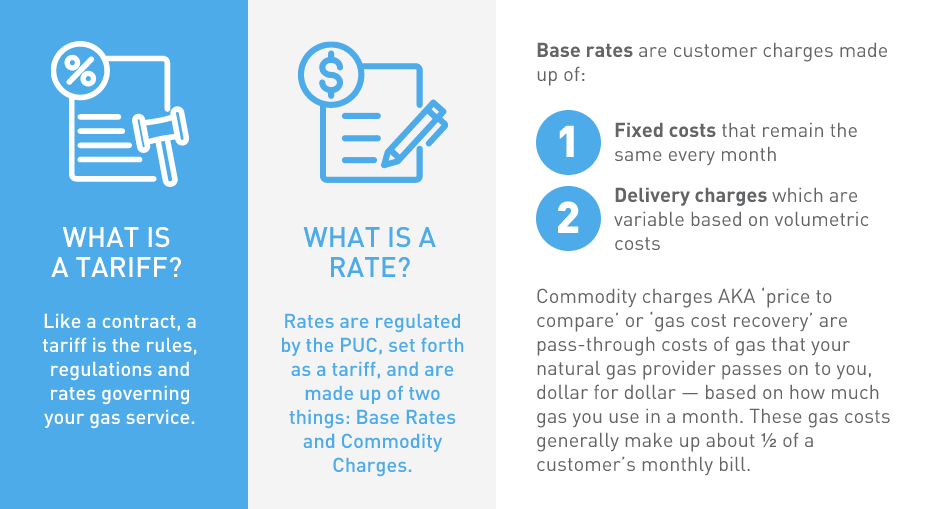
Your gas bill is made up of two separate components: base rates and commodity costs. Watch the video at the top of this page for a breakdown of what your natural gas bill pays for each month.
Base rates are charges related to the delivery of your natural gas through our pipeline infrastructure. They also cover the costs to operate and maintain our pipeline distribution system, which entails more than 15,000 miles of pipeline throughout our 18-county service territory. Each year, Peoples replaces approximately 200 miles of aging infrastructure with new pipelines in order to continue providing safe and reliable service, while also reducing greenhouse gas emissions.
Commodity (or gas) costs generally represent about half of a customer's bill and are adjusted quarterly based on market conditions. Peoples does not profit from commodity or capacity costs of gas; we are required by law to buy the most reliable gas supply at the lowest available cost.
Peoples purchases gas for its customers and passes along the cost without benefit to the company. Customers are able to choose other suppliers through the Customer Choice Program. Be sure to check the supplier rates against Peoples’ Price to Compare, listed on our website and every bill we issue, to ensure you are receiving the most competitive rate.
Why does Peoples need to adjust its rates?
As part of Peoples’ commitment to maintaining the safe, reliable delivery of natural gas through its 15,000 miles of pipeline infrastructure, we are in the midst of investing more than $600 million per year to replace and modernize close to 900 miles of aged pipe between 2026 and 2030.
Since 2013, we’ve replaced more than 1700 miles of pipeline with state-of-the-art materials, providing a safer, more reliable gas distribution network to our communities. In 2026 and 2027 alone, we plan to invest over $1.1 billion to upgrade and replace 372 miles of pipelines and related facilities.
We are requesting a rate adjustment with the PUC to recover and offset some of the costs associated with modernizing aging infrastructure.
What does "aging infrastructure" mean?
Upgrading and modernizing infrastructure is a significant challenge our entire country faces. It’s easy for us all to see the wear and tear on roads and bridges, but the natural gas pipelines that power and heat your homes and businesses are buried under our feet. As these pipelines age, they face the same challenges as roads and bridges: corrosion, damage from digging impacts, ground shifting, flooding and more. Older pipelines may be made of bare steel, cast iron and other materials, which grow more susceptible to leaks as they age.
We will prioritize the most at-risk components of our distribution system first, upgrading aging pipes with state-of-the-art materials that limit leaks and corrosion and are flexible to withstand freeze and thaw cycles.
Since beginning our Long Term Infrastructure Improvement Plan in 2013, we’ve replaced close to 2,000 miles of aged pipelines on our way toward a goal of replacing 4,070 miles of aged pipelines by 2038. These enhancements allow you and your family to continue to enjoy the benefits of natural gas safely, reliably and efficiently, for generations to come.
When was the last time Peoples asked to adjust its rates?
The last base rate change for Peoples Natural Gas customers took effect in the fall of 2024.
Didn’t Peoples just request to adjust rates earlier in 2026?
The request filed on March 27, 2026 is to adjust our ‘base rate’ costs. It is separate and unrelated to the natural gas cost rate adjustments filed in February and March. Please see the above section About Base Rates and Gas Cost Adjustments for an explanation of the difference between base rates and gas cost rates.
Commodity/capacity or gas costs generally represent about half of a customer’s bill. We purchase gas for customers who have not signed up for the Customer Choice Program. We then pass that cost along to the customer with no mark-up or profit, meaning the gas cost portion of a residential customer’s monthly bill is based entirely on their monthly gas consumption and the delivery of the gas they use. The gas cost rate is adjusted on a quarterly basis, with the next adjustment occurring on April 1, 2026.
Peoples does not benefit from commodity or capacity costs of gas; we are required by law to buy the most reliable gas supply at the lowest available cost.
How much does modernizing infrastructure cost?
It is a costly process to retire aged pipelines and replace them with new, state-of-the-art materials. In an urban area, our costs to take aging pipeline out of service, install a new line, and restore the street back to an even better condition can cost $2.5 million per mile.
When will this adjustment be reflected on my bill?
The PUC will review the base rate adjustment request and grant all, some or none of the request. We expect customers will see the base rate adjustment reflected on their bills at the end of December 2026.
Don’t I already pay a DSIC fee for infrastructure improvement?
Many Peoples customers are currently paying a Distribution System Improvement Charge (DSIC). This charge allows us to replace aging infrastructure without increasing base rates. The amount of the DSIC is capped at 5.0% of the amount billed to customers for distribution services and thus only allows the Company to recover a small portion of the modernization investments made. While the DSIC enables us to make enhancements without changing base rates, it is not sufficient to cover all of the significant investments Peoples is making to modernize its infrastructure for continued safe, reliable delivery of natural gas to customers.
If the PUC approves our request to increase base rates, the DSIC charge will be reset to zero once the new rates go into effect.
What will my bill cost now?
No two customers’ bills are the same. Bills will fluctuate based on seasonal changes and customer usage. The PUC will review the base rate adjustment request and grant all, some or none of the request. We expect customers will see the base rate adjustment reflected on their bills beginning in December 2026.
If the full base rate adjustment request is approved, the total bill for a residential customer who uses 86 Mcf of gas per year will increase by $16.03 per month.
What are the benefits to customers from this rate adjustment?
We’re committed to keeping our communities and our environment safe. When we replace aged infrastructure, this ensures we can safely and reliably provide natural gas for heating, cooking and powering homes and businesses in our region.
Modernizing our infrastructure also makes our distribution system cleaner. We have reported that as of December 31, 2024, Peoples has reduced its Scope 1 Greenhouse Gas (GHG) emissions approximately 20% from 2019 baseline levels. This reduction is achieved primarily through Peoples replacing old lines with pipes made from state-of-the-art materials, and drives much of the progress of our parent company, Essential Utilities, to its goal of reducing emissions 60% emissions reduction from 2019 levels by 2035.
Finally, being able to properly fund these modernization projects supports hundreds of jobs right here in Southwestern Pennsylvania, many of which are well-paying union positions. Peoples is an economic driver, and the natural gas we provide allows businesses to get more cost-effective energy than were it to come from other sources.
What are the benefits of natural gas?
There are many benefits of natural gas. It is an essential energy source that supplies nearly one-third of all the energy in the United States. It is the earth’s cleanest traditional fuel and is safe, reliable and accessible. Natural gas is, on average, 3.3 times more affordable than electricity, according to a 2023 analysis from the U.S. Department of Energy.
Natural Gas is also very reliable, with only 1 in 800 gas utility customers experiencing an unplanned outage in the average year, according to the American Gas Association.
The growing usage of natural gas has also led to a better environment. Pennsylvania’s energy-related carbon dioxide emissions dropped 30% between 1970 and 2021, according to the U.S. Energy Information Administration. Energy-related CO2 emissions also recently hit a 30-year low thanks in large part to the growth of natural gas as an energy source, according to the AGA. Emissions from natural gas distribution systems in the U.S. have also decreased by 69% since 1990, thanks to infrastructure modernization and improved leak detection and repair processes.
If I'm struggling to pay my bill, what help is available?
Customers who may need assistance paying their bills are encouraged to use our ProgramFinder to see if they are eligible for Customer Assistance Programs such as the Low Income Energy Assistance Program (LIHEAP) and the Dollar Energy Fund. For more information, click here or call 1-800-WARM (9276).
Weather Normalization Adjustment (WNA)
The PUC approved Peoples’ use of a Weather Normalization Adjustment (WNA) mechanism beginning with bills rendered on October 1, 2024. WNA is a method to adjust a customer’s bill due to variations from expected temperatures, and is used by many gas utilities in Pennsylvania and elsewhere. The WNA will make bills more predictable by making an adjustment for the difference between actual temperatures and normal temperatures if conditions differ from normal by more than three percent (3%). The WNA will only be applied to bills rendered between October 1 and May 31. Learn more about the Weather Normalization Adjustment
Kentucky Tariffs & Rates
Peoples has a sister utility in Kentucky, Delta Natural Gas, which serves approximately 40,000 customers in the Bluegrass State. Delta Natural Gas also includes customers of the former Peoples Gas Kentucky. Delta is regulated by the Kentucky Public Service Commission.
Our Kentucky rates can be found on the Delta Natural Gas Company website.