
Contact Us
To Report an Emergency:
Call 1.800.400.4271 (24 hours/7 days)
Please use this line ONLY for emergencies.
Customer Service:
Call: 1.800.764.0111
Mon. - Fri. 7:00 a.m. - 5:00 p.m. EST
Individuals with Hearing Loss:
Call: 711 or 1.800.654.5988
TTY #: 1.800.654.5984
Write to Us:
Peoples
P.O. Box 535323
Pittsburgh, PA 15253-5323
Natural Gas Safety

Stay Safe with Natural Gas: What You Need to Know
The safety of our customers, employees and communities is our top priority. We work tirelessly to ensure our practices are as safe as possible, and we want you to feel confident and informed when it comes to natural gas safety.
While natural gas leaks are rare, they can pose serious risks, including fire, explosion, or asphyxiation. Leaks can result from events like damaged pipelines, heavy ice on meters, water main breaks, or even natural disasters.
This page is your go-to resource for staying safe. Learn what to do if you smell gas, how to dig safely, and other essential tips to protect yourself and your community. And know that we are just a phone call away, at all hours of the day: call 1-800-400-4271 to report an emergency to our 24-hour-hotline.
Together, we can ensure natural gas remains a safe and reliable energy source!
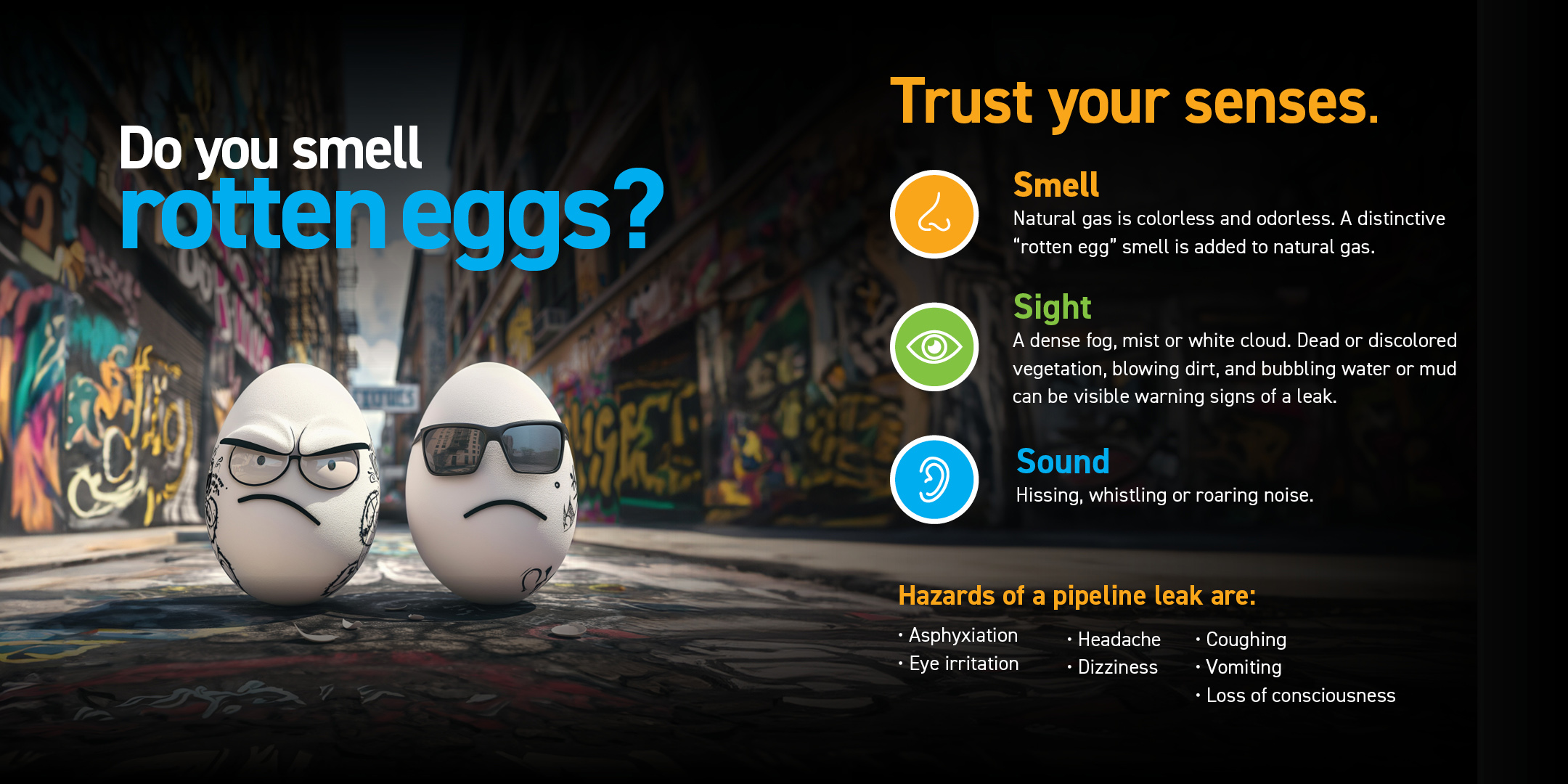
Trust Your Senses
Always trust your senses. If you suspect a natural gas leak, immediately leave the home, building, or area of the suspected leak. Get to a safe location, warn others to stay out of the area, and call 911 and our emergency hotline: 1-800-400-4271.
Essential Natural Gas Safety Tips
Knowing what to do—and what not to do—when it comes to natural gas can make all the difference in staying safe.
DOs:
If you smell a sulfur-like, rotten egg odor: Leave the area immediately and call 911, and our emergency hotline at 1-800-400-4271.
- If you see a line of brown, dry grass in an otherwise moist area: Call our emergency number at 1-800-400-4271.
- Keep the area around your gas meter clear of debris.
- Check outdoor appliance exhausts year-round to ensure they are clear.
- Install a carbon monoxide detector and test it regularly.
- Maintain your furnace by changing filters as required and performing regular checks.
- Ask to see ID when a Peoples worker visits to service your gas line or appliances.
- Call 811 before uprooting trees or shrubs to ensure it’s safe and avoid damaging gas pipelines.
DON’Ts:
If you smell natural gas or see/hear signs of a leak: Do NOT attempt to find the source. Leave the area immediately and call 911, and our emergency hotline at 1-800-400-4271.
- Do NOT touch, breathe in, or make contact with a gas leak.
- Do NOT light matches, turn light switches on/off, use phones, or create sparks.
- Do NOT open windows if you smell natural gas—it could make the area more unsafe.
- Do NOT attempt to extinguish a fire or operate any valves.
- Do NOT start a car or operate an automatic garage door near a gas leak.
- Do NOT store flammable products or keep combustible materials near your natural gas appliances
- Do NOT use weed-whackers or lawn mowers close to your gas meter.
- Do NOT tie pets to your gas meter.
Safety Tagging: When We Notify You
To keep you safe, we may contact you with important home safety updates. When our team visits to service your gas line or appliances, always ask for photo ID—our employees are required to wear one. If you have concerns, call our Customer Service Center at 1-800-764-0111.
Red Tags, Yellow Tags & Door Hangers
Red Tag
If you find a Peoples “Red Tag” on an appliance or valve, then there is a problem with your piping or appliance. A "Red Tag" is also known as “Appliance or Piping Shut Off Notice." It is placed on an appliance or pipe by a Peoples employee to make the customer aware of a dangerous situation that the employee discovered during our visit. You should read the Red Tag for an explanation of the unsafe condition.
As instructed on the Red Tag, if you see a Red Tag, you MUST contact a qualified person (we suggest a professional natural gas plumber) to resolve the unsafe condition before the supply of gas is restored to that appliance or section of pipe. The customer should not operate the tagged appliance or section of pipe until the defect has been repaired or replaced.
The customer does not need to contact Peoples to remove a Red Tag. A qualified person can remove the Red Tag after the issues listed on the tag are resolved.
For help locating a qualified person or plumber, please contact the Better Business Bureau at 412-456-2700 or visit their website at www.bbb.org.
Yellow Tag
Also known as a “Live Gas To This Point Notice,” a Peoples “Yellow Tag” is placed on gas valves by Peoples employees to make you aware that there is natural gas against that valve in your house piping. If that valve is opened, gas will flow beyond that point. Only a qualified person should operate the valve.
The customer does not need to contact Peoples to remove a Yellow Tag. The Yellow Tag may be removed after a qualified person opens the tagged valve.
For help locating a qualified person, please contact the Better Business Bureau at 412-456-2700 or visit their website at www.bbb.org.
Door Hangers
If Peoples needs to get in touch with you, but you are not home, we may leave a door hanger. There are a few different reasons why we might leave a door hanger, such as:
- Working near your home
- Service call, meter read, etc.
- Non-access to meter, theft, tampering
- Bills past due
- Cross Bores Safety Inspection
Each door hanger will provide you with the next steps you should take. If you have any questions, feel free to give our Customer Service Center a call at 1-800-764-0111.
Resources
- Learn more about Natural Gas Safety from our our Play It Safe brochure.
- Want to help your child learn about natural gas safety with a fun activity? Check out our Freddy Facts coloring book featuring our mascot, Freddy the Flame!
Become E-SMART: Safety for Every Audience
- We’re committed to helping everyone become e-SMART—learning how to use natural gas safely and responsibly. Whether you’re a parent teaching your kids, a contractor working near gas lines, or a first responder handling emergencies, we have tailored resources for you. Explore games and activities for kids, safety practices and case studies for workers, and advanced training tools for first responders. Stay informed, stay safe, and become e-SMART today!